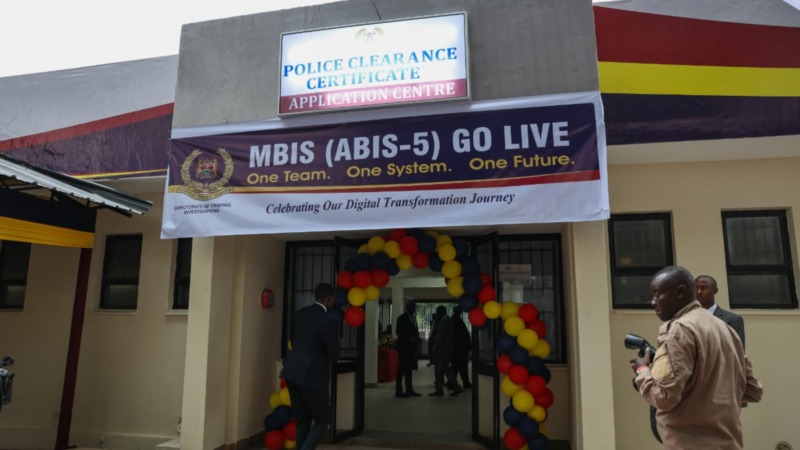
Kenyans seeking police clearance certificates will soon receive them within 24 hours following the rollout of a new biometric identification system aimed at eliminating long processing delays.
Interior Cabinet Secretary Kipchumba Murkomen said the Multi-Biometric Identification System (MBIS) marks a major improvement in service delivery, reducing the waiting period from up to two weeks or more to just one day.
Murkomen said the move was informed by concerns raised by members of the public during the government's Jukwaa la Usalama forums, where delays in obtaining police clearance certificates featured prominently.

"People repeatedly told us that police clearance certificates take too long. Today, we are providing the answer to those complaints," he said.
Speaking at the Directorate of Criminal Investigations (DCI) headquarters during the handover of the ANSI National Accreditation Board (ANAB) Certificate to the Forensic Evidence Management Unit (FEMU) and the launch of the ABIS version of the MBIS, the CS said the new system will improve both public services and criminal investigations.
The MBIS replaces the Automated Palm and Fingerprint Identification System (APFIS), which was introduced in 2016. According to the CS, the upgraded platform increases biometric records capacity from two million to 10 million and boosts daily fingerprint searches from 4,500 to 20,000.
Murkomen said the government will gradually introduce biometric enrolment at police stations across the country to bring services closer to wananchi.

He added that plans are underway to integrate the system with the National Registration Bureau, the Judiciary, Immigration and Interpol to enable faster identity verification, intelligence sharing and more efficient investigations.
The Interior CS said the technology will also strengthen efforts to identify repeat offenders and prevent criminals from exploiting gaps in government records.
The launch coincided with the accreditation of the DCI's Forensic Evidence Management Unit, a move expected to enhance the quality and international credibility of forensic evidence used in criminal investigations.